A $15 Rechargeable Battery Kit Pays for Itself in 3.3 Months
A typical household burns through about $5/month in disposable batteries — the kind you buy in a panic at the checkout lane. A rechargeable starter kit costs $15 upfront and roughly $0.50/month after that. It's not glamorous savings, but it's the kind that never stops compounding.
Payoff Time
3.3 mo
Rechargeable batteries vs Disposable Batteries
Product cost
$15
one-time
Annual savings
$54
vs Disposable Batteries
The Setup: The Junk Drawer Tax
Nobody budgets for batteries. They just… appear on receipts. A four-pack here for the TV remote, another there for the kid's toy, a couple more for the wireless mouse that dies during a Zoom call. At roughly $1.25 per AA or AAA, a household cycling through about 4 batteries a month spends around $60 a year on cells that go straight into the trash.
Rechargeable batteries flip that script. You buy a charger and a set of NiMH cells once, plug them in when they die, and repeat that cycle hundreds of times. The electricity cost is genuinely negligible — we're talking fractions of a penny per charge. The only ongoing expense is replacing a cell every couple of years as capacity naturally degrades, which works out to about $0.50/month averaged over time.
The Math
A solid rechargeable starter kit — charger plus pre-charged AA batteries — runs about $15. Your old disposable habit costs roughly $5/month. The rechargeable setup costs about $0.50/month in upkeep. That's a net savings of $4.50/month, which means the $15 investment pays for itself in about 3.3 months.
After that? You're pocketing roughly $54 per year, every year. Not life-changing money, but it's the equivalent of getting a free streaming subscription — funded entirely by batteries you're no longer throwing away.
| Rechargeable batteries | Disposable Batteries | |
|---|---|---|
| Upfront cost | $15 | $0 |
| Monthly ongoing | $0.50 | $5 |
| Month 1 total | $16 | $5 |
| Month 2 total | $16 | $10 |
| Month 3 total | $17 | $15 |
| Month 4 total | $17 | $20 |
| Year 1 total | $21 | $60 |
| Year 3 total | $33 | $180 |
| 5-year total | $45 | $300 |
* All figures are estimates. See methodology for assumptions.
Cumulative Cost Over Time
The lines cross at the breakeven point — that's when the savings zone begins.
When This Doesn't Pay Off
If you barely use batteries — maybe one pack of AAs every few months for a single remote — the savings shrink to the point where breakeven stretches past a year, and the annual return is pocket change. The math favors households that actually go through batteries regularly: game controllers, kids' toys, wireless keyboards, flashlights, that sort of thing. If your junk drawer has had the same half-dead Duracell in it since 2021, this isn't your fight.
There's also a convenience trade-off. Disposables are instant: rip open the pack, pop them in, done. Rechargeables require a tiny bit of planning — you need a charged set ready to rotate in. Most people adapt in a week, but if you're the type who only remembers batteries exist at 10 PM on a Sunday when the remote dies, the first month might feel annoying.
Finally, not all devices love rechargeables equally. NiMH cells run at 1.2V instead of the 1.5V of alkalines, which is fine for 95% of gadgets but can cause issues in a few high-drain or voltage-sensitive devices. Check your smoke detectors — most manufacturers still recommend disposable lithium or alkaline for those.
Sensitivity Analysis: Your Results May Vary
Payoff time changes based on how much you currently spend.
Heavy use (6+ batteries/mo)
A battery-hungry household with game controllers, kids' toys, and multiple wireless devices saves $7/mo and breaks even in just 2.1 months.
2.1mo
$84/yr
Typical use (4 batteries/mo) (our base case)
A standard household running through about 4 AA/AAA batteries per month across various gadgets saves $4.50/mo and breaks even in 3.3 months.
3.3mo
$54/yr
Light use (2 batteries/mo)
A low-battery household swapping about 2 cells per month — maybe just remotes and a mouse — saves $3/mo and breaks even in 5.0 months.
5mo
$36/yr
"A $15 rechargeable battery kit pays for itself in 3.3 months, then saves you $54 every year — all by ending your quiet disposable battery habit."
What We Recommend
We picked three rechargeable battery kits at different price points, all of which hit the payoff math above assuming ~4 batteries per month in usage. The budget option gets you started for less than the cost of three packs of disposables; the premium kit loads you up with 8 high-capacity cells and a fast USB charger so you're never caught short.
Energizer Recharge Pro Rechargeable AAA and AA Battery Charger With 4 NiMh Rechargeable AA Batteries, Provides a Full Charge in 3 Hours

$13
upfront
2.9mo
payoff
$54
/ year
The Energizer Recharge Pro is the cheapest way in at just $13. You get a charger and 4 AA cells — enough to start rotating one set while the other charges. It's bare-bones but perfectly functional, and at this price your breakeven drops to roughly 3 months. Great if you want to test the rechargeable life before going all-in.
Check current price →Price shown is approximate. Click for current price. Affiliate link.
Amazon Basics 4-Bay Battery Charger for AA & AAA Rechargeable Batteries with Pre-Charged AA NiMh Batteries, LED Operation, Type A (American) Plug, 4 Count, Black

$15
upfront
3.3mo
payoff
$54
/ year
The Amazon Basics 4-Bay Charger kit hits a sweet spot at $15: you get the charger plus pre-charged NiMH AA batteries ready to use out of the box. The LED status indicators are a nice touch so you actually know when charging is done. It's the boring-in-a-good-way pick — reliable, affordable, and backed by Amazon's easy return policy.
Check current price →Price shown is approximate. Click for current price. Affiliate link.
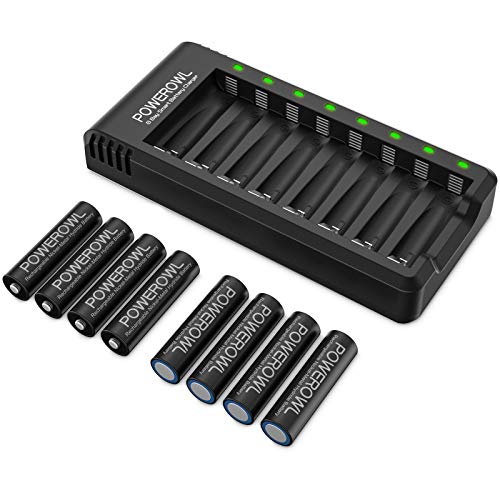
POWEROWL Rechargeable AA Batteries with Charger, 8 Pack of 2800mAh High Capacity Low Self Discharge Ni-MH Double A Batteries with Smart 8 Bay Battery Charger (USB Fast Charging, Independent Slot)
$25
upfront
5.6mo
payoff
$54
/ year
The POWEROWL 8-pack kit is the "never think about batteries again" option. Eight 2800mAh high-capacity AAs plus a smart 8-bay USB charger with independent slots means you can charge different battery types simultaneously. At $25, it's still well under our $35 assumption, which means an even faster payoff — and you'll have a full rotation of cells so you're never waiting on a charge.
Check current price →Price shown is approximate. Click for current price. Affiliate link.
What we didn't account for
- → Battery lifespan varies We assumed rechargeable cells last 2–3 years before capacity degrades enough to need replacing. Heavy use, cheap cells, or improper charging can shorten that. Quality NiMH batteries rated for 500+ cycles will get you there; dollar-store rechargeables may not.
- → Electricity cost is hand-waved We called the electricity cost "negligible" because it genuinely is — roughly $0.50/year to charge 8 AA batteries weekly. But we didn't factor in any specific utility rate; yours may differ by a few cents.
- → Disposable prices fluctuate We used ~$1.25 per AA battery, which is a reasonable average for name-brand alkalines bought in mid-size packs. Bulk warehouse packs can drop below $0.50/cell, which would significantly slow your breakeven.
- → Smoke detectors are excluded Most fire safety agencies recommend non-rechargeable lithium or alkaline batteries for smoke and CO detectors. Don't swap those out — the math here assumes everyday household gadgets only.